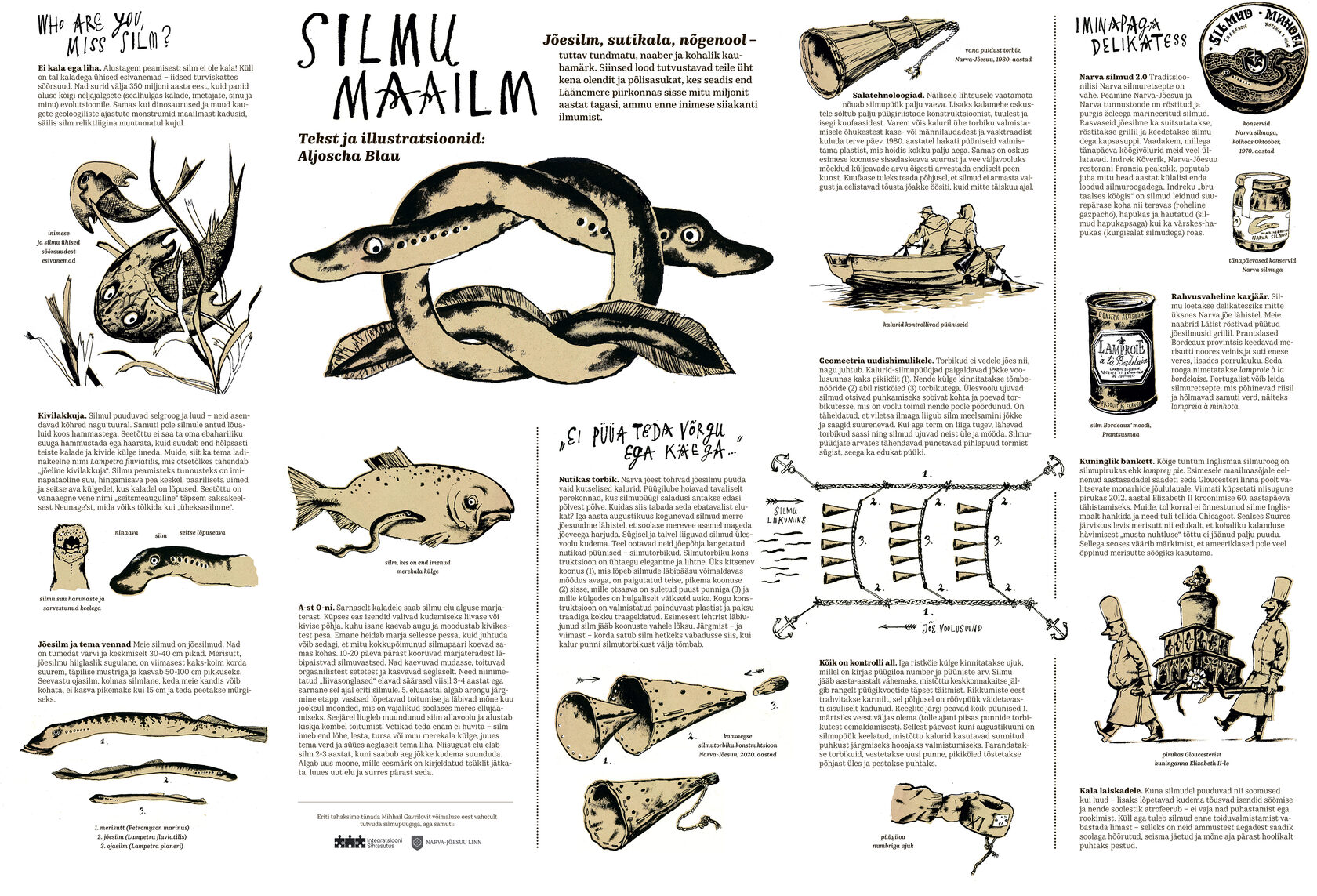
River lamprey, “little eel fish”, “nettle arrow” — a familiar stranger, a neighbour and a local brand. The following stories introduce a remarkable creature and long-standing inhabitant that settled in the Baltic Sea region millions of years ago, long before humans appeared here.
Neither Fish nor Fowl
Let us begin with the main point: the lamprey is not a fish. It belongs to the group of jawless vertebrates (Agnatha) and shares distant common ancestors with fish — the ancient armoured jawless vertebrates known as ostracoderms. These disappeared about 350 million years ago, but they laid the evolutionary foundation for all vertebrates, including fish, mammals — and you and me. While dinosaurs and many other creatures of distant geological eras vanished, the lamprey survived as a relict species, preserving a body plan that has remained remarkably unchanged for millions of years.
The Stone-Licker
The lamprey has neither a true spine nor bones — these are replaced by cartilage, similar to that of the sturgeon. It also lacks jaws and true biting teeth. As a result, it cannot bite or grasp prey in the way typical fish do. Instead, with its unusual circular mouth, it can easily attach itself to other fish or to stones. Incidentally, this explains its Latin name, Lampetra fluviatilis, which can be interpreted as meaning “river stone-licker.” The word lampetra derives from Latin roots referring to licking or sucking at stones.
The lamprey’s main distinguishing features include a suction-cup-like mouth, a single median nostril (a breathing opening) on the top of the head, unpaired fins, and seven gill openings on each side of the body — where bony fish would have gill covers. For this reason, the old Russian name “semidyrka” (“seven-holed one”) is anatomically more accurate than the German Neunauge, which literally translates as “nine-eyed,” referring to the seven gill openings plus the eye and nostril openings.
The lamprey’s main distinguishing features include a suction-cup-like mouth, a single median nostril (a breathing opening) on the top of the head, unpaired fins, and seven gill openings on each side of the body — where bony fish would have gill covers. For this reason, the old Russian name “semidyrka” (“seven-holed one”) is anatomically more accurate than the German Neunauge, which literally translates as “nine-eyed,” referring to the seven gill openings plus the eye and nostril openings.
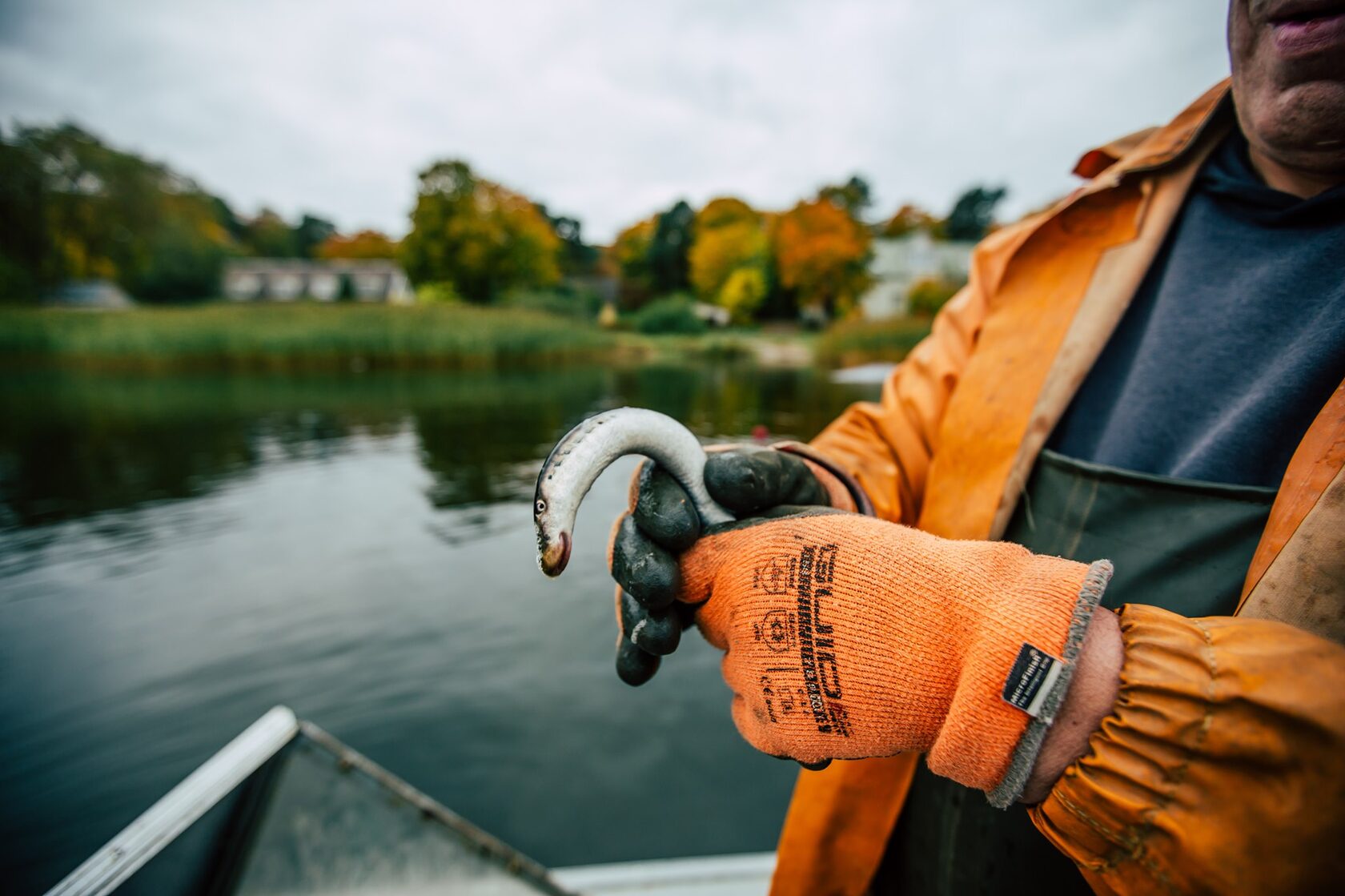
Lamprey in the hands of a local fisherman in Narva-Jõesuu. Photo: Anna Markova
River Lamprey and Its Relatives
The lampreys found in our region are river lampreys (Lampetra fluviatilis). They are dark in colour and typically measure 30–40 cm in length. The sea lamprey (Petromyzon marinus), a much larger relative of the river lamprey, is two to three times bigger, has a mottled pattern, and can grow to 50–100 cm in length. By contrast, the brook lamprey (Lampetra planeri), the third lamprey species that may be encountered in our area, does not grow longer than about 15 cm. It is sometimes considered “poisonous” in local folklore, although scientifically it is not venomous; rather, it is simply not used for food and is of no commercial value.
From A to O — The Lamprey Life Cycle
Like fish, the life of a lamprey begins with eggs. Mature individuals select sandy or gravelly riverbeds for spawning. The male excavates a shallow depression and builds a nest from small stones. The female deposits her eggs into this nest; sometimes several intertwined pairs spawn in the same location. After 10–20 days, transparent larvae hatch from the eggs. These larvae, known scientifically as ammocoetes, burrow into the sediment, where they feed on organic detritus and microorganisms filtered from the substrate. They grow slowly and may live in this larval stage for 3–4 years. During this period, they do not closely resemble adult lampreys.
In their fifth year, the next stage of development begins. The larvae stop feeding and undergo a metamorphosis lasting several months, during which their bodies transform into the parasitic form capable of surviving in saltwater. After metamorphosis, the transformed lamprey drifts downstream into the sea and begins feeding as a parasite.
Algae no longer interest it. Instead, the lamprey attaches itself to salmon, flounder, cod or other marine fish, feeding on their blood and gradually consuming tissue. It lives this way for 2–3 years until it reaches sexual maturity and returns to freshwater to spawn. Another transformation begins, allowing the cycle to continue: reproduction, the creation of new life — and death shortly thereafter, as adult lampreys typically die after spawning.
In their fifth year, the next stage of development begins. The larvae stop feeding and undergo a metamorphosis lasting several months, during which their bodies transform into the parasitic form capable of surviving in saltwater. After metamorphosis, the transformed lamprey drifts downstream into the sea and begins feeding as a parasite.
Algae no longer interest it. Instead, the lamprey attaches itself to salmon, flounder, cod or other marine fish, feeding on their blood and gradually consuming tissue. It lives this way for 2–3 years until it reaches sexual maturity and returns to freshwater to spawn. Another transformation begins, allowing the cycle to continue: reproduction, the creation of new life — and death shortly thereafter, as adult lampreys typically die after spawning.
Lamprey Fishing
You do not catch it with a net — nor with your bare hands…
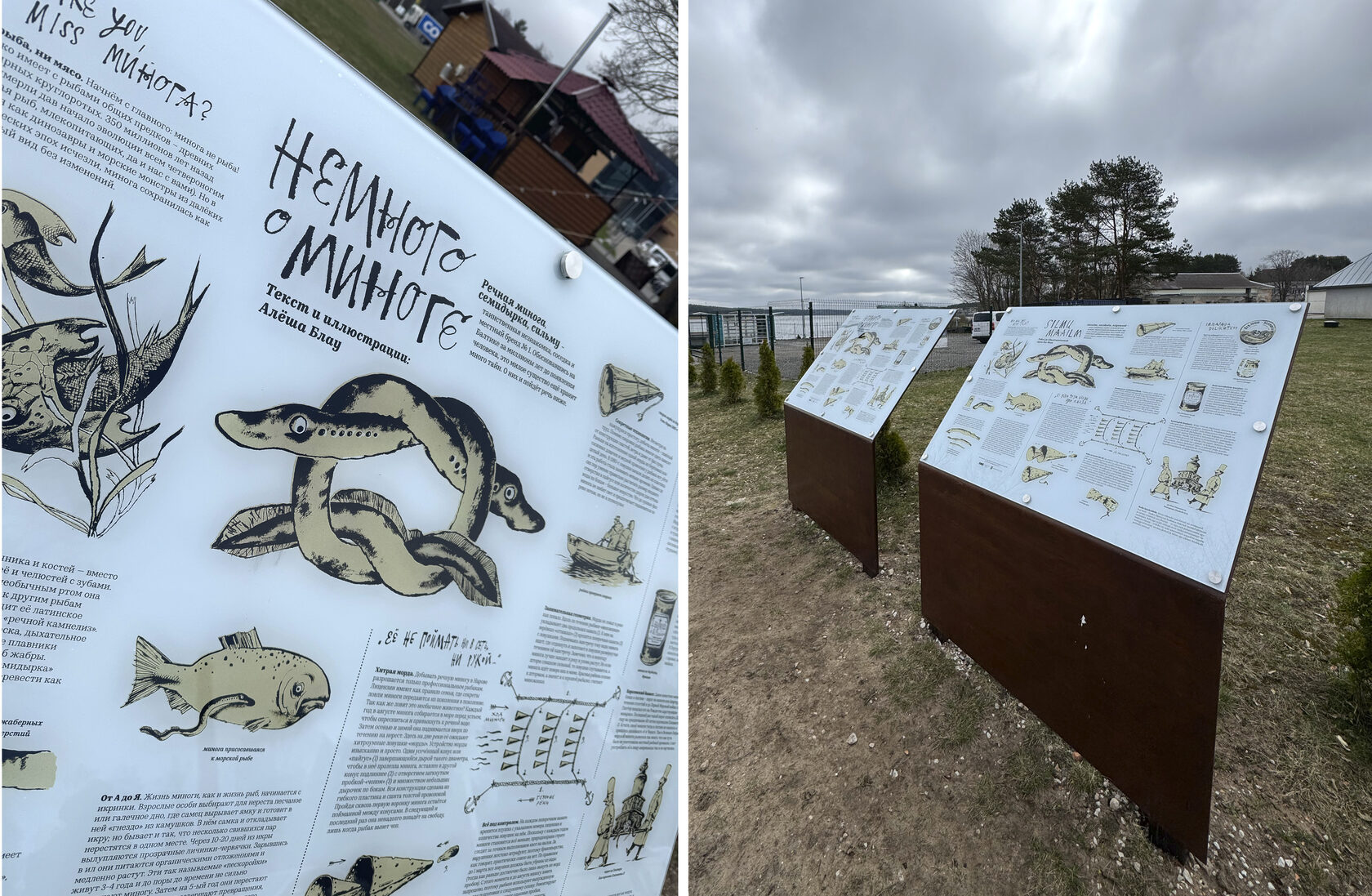
Outdoor exhibition about lamprey at Narva-Jõesuu Harbour. Text and illustrations: Aljoscha Blau.
The Ingenious Funnel
Only licensed professional fishermen are permitted to catch river lamprey in the Narva River. Fishing rights are typically held by families, with the knowledge and techniques of lamprey fishing passed down from generation to generation. Each year in August, lampreys gather in the sea near the river mouth to acclimatise from saltwater to freshwater. In autumn and winter, they migrate upstream to spawn. Along the way, they encounter cleverly designed traps lowered to the riverbed — the so-called lamprey funnels.
The construction of a lamprey funnel is both elegant and simple. A narrowing inner cone, ending in an opening just wide enough for a lamprey to pass through, is placed inside a longer outer cone. The outer cone is closed at the end with a wooden plug and has numerous small holes along its sides. The entire structure is made of flexible plastic and secured together with thick wire. After swimming through the first funnel, the lamprey becomes trapped between the two cones. The next — and final — moment of freedom occurs only when the fisherman removes the wooden plug to empty the trap.
The construction of a lamprey funnel is both elegant and simple. A narrowing inner cone, ending in an opening just wide enough for a lamprey to pass through, is placed inside a longer outer cone. The outer cone is closed at the end with a wooden plug and has numerous small holes along its sides. The entire structure is made of flexible plastic and secured together with thick wire. After swimming through the first funnel, the lamprey becomes trapped between the two cones. The next — and final — moment of freedom occurs only when the fisherman removes the wooden plug to empty the trap.
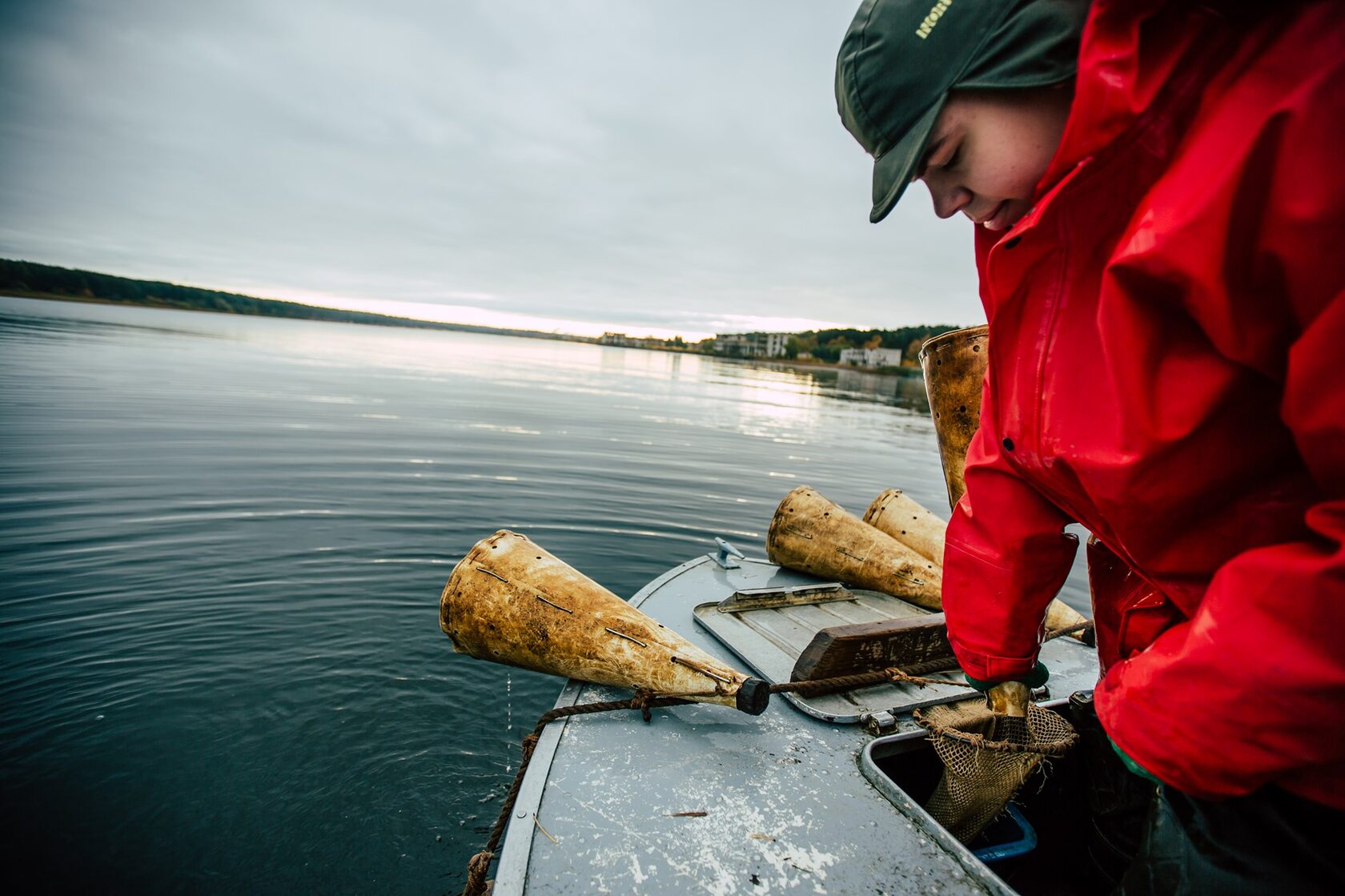
Lamprey traps (funnel pots). Photo: Anna Markova.
Hidden Technologies
Despite its apparent simplicity, lamprey fishing requires considerable effort. In addition to the fisherman’s skill, success depends on the design of the gear, wind conditions and even the phases of the moon. In the past, crafting a single lamprey trap from thin birch or pine slats and copper wire could take an entire day. Since the 1980s, traps have been made from plastic, significantly reducing production time. Nevertheless, determining the correct diameter of the inner funnel opening and the number of side holes for water outflow remains a subtle and highly specialised craft. Knowledge of lunar phases also plays a role. Lampreys avoid light and prefer to migrate upstream at night — though typically not during a full moon, when increased illumination can reduce their movement.
Geometry for the Curious
The traps are not simply scattered in the river at random. Lamprey fishermen install two long lines in the river, aligned with the direction of the current. Cross-lines with traps attached are secured to them using draw-ropes. As lampreys swim upstream, they search for places to rest and slip into the traps, which are positioned facing into the current. Observations show that in poor weather conditions lampreys tend to migrate more actively into the river, and catches increase accordingly. However, if the storm is too strong, the traps may become tangled, allowing lampreys to swim over or past them. Among lamprey fishermen, there is also a traditional belief: when rowan trees are heavy with red berries, it signals a stormy autumn — and therefore a successful fishing season.
Everything Under Control
Each cross-line is fitted with a float indicating the fishing licence number and the number of traps attached. As lamprey stocks have declined over the years, environmental authorities strictly monitor compliance with catch quotas. Violations are subject to substantial fines, and as a result, illegal fishing has reportedly become virtually nonexistent. According to regulations, all traps must be removed from the water by 1 March. From that date until August, lamprey fishing is prohibited. During this closed season, fishermen use the enforced break to prepare for the next season: traps are repaired, new wooden plugs are carved, the long lines are lifted from the riverbed and cleaned.
A delicacy with a suction cup
Narva-Jõesuu Lamprey Festival, September 2025. Photo: Anna Markova
Narva Lampreys 2.0
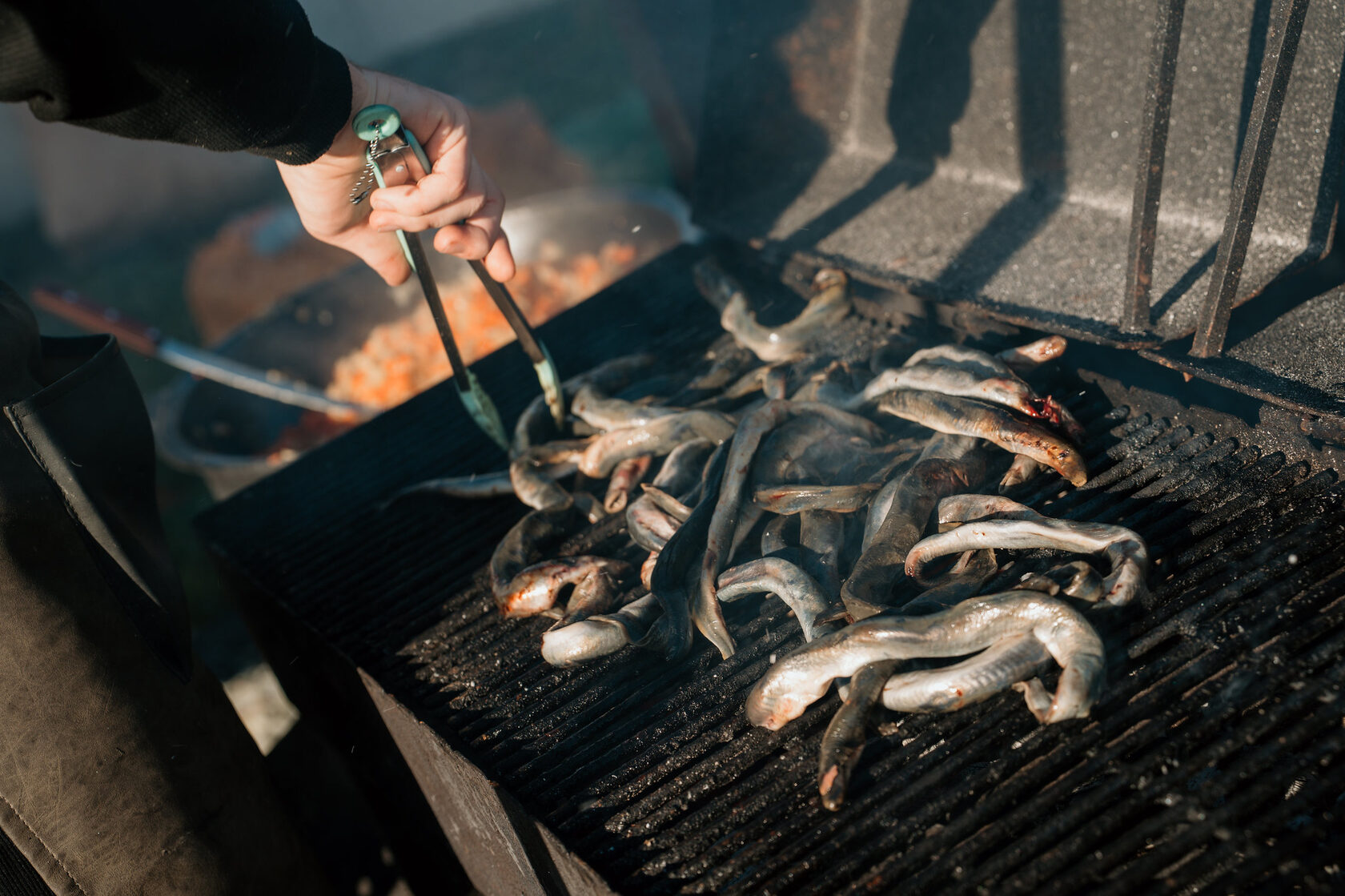
There are only a few traditional Narva lamprey recipes. The main signature product of Narva-Jõesuu and Narva is fried lamprey marinated in jelly and preserved in jars. Fatty river lampreys are also smoked, grilled and used in cabbage soup. Let us see how contemporary culinary masters are reinterpreting this ingredient. Indrek Kõverik, head chef of the Narva-Jõesuu restaurant Franzia, has for several years been delighting guests with his own lamprey creations. In Indrek’s “brutal kitchen,” lamprey has found an excellent place in spicy dishes (green gazpacho), in tangy and braised combinations (lamprey with sauerkraut), as well as in fresh and slightly sour preparations (cucumber salad with lamprey).
International Career
Lamprey is considered a delicacy not only along the Narva River. In neighbouring Latvia, freshly caught river lampreys are grilled over open fire. In France, in the Bordeaux region, sea lamprey is cooked in young wine and its own blood, with leeks added; this dish is known as lamproie à la bordelaise. In Portugal, lamprey recipes often include rice and likewise incorporate the fish’s blood — for example, lampreia à minhota.
A Royal Banquet
The best-known lamprey dish in England is lamprey pie. In the centuries before the First World War, the city of Gloucester traditionally presented this pie to reigning monarchs for their Christmas table. Most recently, such a pie was baked in 2012 to mark the 60th anniversary of the coronation of Elizabeth II. On that occasion, it proved impossible to source lampreys in England, and they had to be ordered from Chicago. In the Great Lakes region of North America, the sea lamprey spread so successfully that the “black scourge” nearly devastated local fisheries. It is worth noting that Americans have not yet adopted sea lamprey as a food source.
Fish for the Lazy
Because lampreys have neither scales nor bones — and because individuals migrating upstream to spawn stop feeding and their intestines atrophy — they do not require scaling or gutting. However, before cooking, lampreys must be freed of their mucus. Since ancient times, this has been done by rubbing them with salt, leaving them to rest, and then thoroughly rinsing them clean after a short while.